That may seem like an odd question given the ubiquity of the term’s usage in the scientific community but it is not. Once you’ve asked the question and go looking for an answer you’ll find that it generates a plethora of incoherent vagaries centered on a shared belief that a photon is a “particle” of some kind. The problem with that belief is that as a vaguely specified component of electromagnetic radiation a photon does not have a rest mass which is a characteristic all other particles share.
In common usage a particle is a small material body, where smallness is a matter of scale. On the scale of the Solar System the Earth is a particle. You can be considered a particle on the scale of the Earth, and a dust mote floating by your nose is a particle on the scale of the room you are in. An electron is a particle on the atomic scale. All of those different scale particles have one thing in common – they are all material bodies. And all material bodies have two fundamental properties – they have rest mass and they are three dimensionally located.
A photon, however vaguely defined, is a component of electromagnetic radiation and as such it has neither rest mass nor 3D locality. Calling a photon a particle is a categorical error. It is characteristic of the kind of sloppy thinking that is pervasive in Modern Theoretical Physics.
So a photon is not a particle, but what is a photon? This Wiki article gives a typically garbled account. That is not a criticism of the Wiki article per se which does a reasonably good job of presenting the standard, painfully incoherent account typical of all things quantum. It’s just that there are numerous descriptions of photon properties but there does not seem to be a single coherent definition on which all the various properties are based. Here is one definition from the Wiki that seems to contain multitudes:
During a molecular, atomic, or nuclear transition to a lower energy level, the photons emitted have characteristic energies ranging from radio waves to gamma rays. Photons can also be emitted when a particle and its corresponding antiparticle are annihilated…
In a quantum mechanical model, electromagnetic waves transfer energy in photons with energy proportional to frequency ()
whereis the Planck constant, a fundamental physical constant.

That means that the energy of a photon varies with the frequency and given there are some 1026 frequencies in the electromagnetic spectrum that’s a lot of unique photons. One can only wonder which of those is the photon that is a fundamental particle in the standard model of particle physics. Perhaps it’s better not to ask.
The photon concept is an incoherent mess in Modern Theoretical Physics, but the substance of the idea – that there is a minimum amount of energy associated with electromagnetic radiation has a solid physical basis. The idea originated with Max Planck who, in 1900, was trying to mathematically model the emission spectrum of a black body over a wide range of temperatures.
There were existing models that worked at either high or low temperatures but not at both. The solution Planck discovered was to assume that the energy existed in discrete units rather than in a continuous stream. Those discrete units had a fixed energy value that came to be known as Planck’s constant, 

It would seem reasonable then that this energy minimum is what the term photon should refer to, especially since Planck’s constant is, by definition, the energy of a single cycle of a one cycle per second wave. To get the total energy contained in one second of a higher frequency wave you multiply the frequency (cycles per second) by the energy of a single cycle (Planck’s constant). This means that for all frequencies, Planck’s constant gives the energy of a single cycle of the wave.
Upon reflection what Planck discovered was a rather mundane but physically and mathematically important fact – waves come in whole cycles. There are no fractional waves; the minimum wave is one cycle and for all electromagnetic frequencies, one cycle always has the same amount of energy. Max Planck backed himself into a fundamental insight about the nature of electromagnetic waves.
In 1905 Einstein wrote a paper that concluded that certain electromagnetic phenomena like the photoelectric effect could best be understood “if the energy of a Maxwellian light wave were localized into point-like quanta that move independently of one another“.1
These basic phenomenological insights of Planck and Einstein were quickly squandered however and photon became a particle and/or a wave of varying frequency but constant photon length – one light second (

Logical clarity with respect to any physical system is something that can only be achieved with some minimal effort to understand the physics of the system, but Modern Theoretical Physics seems to treat any such effort as a waste of its valuable computational time. The results speak for themselves. The enormous incongruity between MTP’s various accounts of physical reality and actual observations would be laughable were it not also a tragic betrayal of basic scientific principles.
The incoherence, absurdity, and illogic of the standard quantum physics account of reality was a deliberate and wholly unnecessary aesthetic choice, essentially resting on lazy assumptions of mathematical convenience which are in turn rooted in a cult-like belief in the pseudo-philosophy of mathematicism which holds that math underlies and determines the nature of physical reality.
Mathematicism is the reason that modern theoretical physicists are unable to think about physics in terms of physics. The only framework they have for thinking about physics is in the form of the mathematical models they were taught constituted fundamental truths – the standard models. So if the standard model of particle physics declares a photon to be a particle even if photons don’t have a typical particle’s defining characteristics, that’s perfectly okay. In MTP beliefs supersede physical reality and basic logic.
This is all inexcusable and unnecessary. Physical reality has a nature unto itself and it is the goal of science generally to tease out the nature of physical reality by close study – of physical reality. This can only be accomplished by not imposing some primitive mathematical, metaphysical, or philosophical beliefs as “first principles”. (First principles being nothing more than an expression of the hubristic conceit that the nature of physical reality can only truly be discerned by rummaging around in the human imagination.)
Mathematical beliefs are unfortunately the bedrock of MTP theories about physical reality and this has produced a cornucopia of incoherent metaphysical claims concerning the fundamental nature of reality. The empirical facts concerning physical reality are superfluous to those theories as far as MTP is concerned.
Returning to the original conception described by Planck-Einstein of the photon as an energy quantum of electromagnetic radiation, it is possible to apply that concept to Maxwell’s wave mechanics and come up with a logically coherent, physical description of the nature of electromagnetic radiation that avoids the wave-particle metaphysics plaguing MTP. Here is a picture of an electromagnetic wave as described by Maxwell’s math:
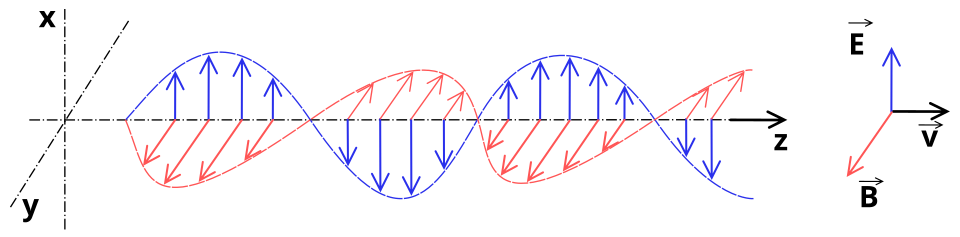
Credit: Wikipedia
We are only concerned here with the first complete cycle depicted, since Planck’s constant defines the energy of a one cycle wave of any frequency. It is possible to interpret this illustration in a way that is consistent with Maxwell’s mathematics and the Planck-Einstein heuristically-derived wave quantum concept. The photon (a quantum of energy defined by Planck’s constant) is emitted by a particle from the particles point-like location on the left of the z-axis and begins oscillating simultaneously in the orthogonally-oriented, two-dimensional planes of the electric and magnetic fields. The electric and magnetic planes combined constitute the four dimensional framework within which the emitted energy oscillates.
At any moment over the course of an oscillatory cycle the energy is distributed sequentially only along one pair of the field lines (arrows) depicted. At any given time during the cycle the energy is always at some particular phase within the cycle; at no point is the energy spread out over the full cycle.
The exceptions to this spread out condition are the three points of divergence-convergence, one at the origin, one at the mid-point of the cycle, and the third at the completion of the cycle. It is at those points of the cycle that all of the energy of the wave has a transient 3D location relative to any 3-dimensional particle like an electron that lies in its path. All emission and absorption events take place along the z-axis of an electromagnetic wave. That axis is sometimes referred to as the null geodesic. In this interpretation a transient particle-like presence is simply an aspect of the four dimensional wave behavior of electromagnetic radiation.
Note that the foregoing considerations do not entail any new or unusual physics or strained metaphysics. All that has taken place is a reordering of our existing knowledge of electromagnetic radiation into physically coherent terms The purpose of this exercise is to demonstrate that the garbled metaphysics of quantum theory (wave-particle duality and superposition of states) is just an aesthetic choice, one that conveys no scientifically meaningful physical information.
So, what is a photon? It is a single cycle of an electromagnetic wave. All photons have the same energy, given by Planck’s constant, that is independent of an electromagnetic wave’s frequency.
1 https://en.wikipedia.org/wiki/Photon#cite_note-Einstein1905-47